Sunday, June 9, 2013

COMMUNITY

Each of us have been members of family, work, social, and worship communities.  Each of us have experienced how fear (often expressed in anger, power struggles, passive-aggressiveness, and more) fosters dysfunction.

We are wondering if anyone has participated in a community where fear, amidst diverse beliefs, has been met with valuable tools of healing and cooperation.  We are attempting to teach and further explore healthy community dynamics in Daughters Of Abraham meetings and through this blog.

Historically in the U.S. Christian churches were often a refuge for immigrants seeking familiar ethnic communities.

The same is true even today for Islam in the United States.   More generally, globally, communal prayer (and some readings of the Quran) require a group.  

Similarly, in Judaism, there are specific prayers, including the prayer for the dead, which require a group. This group, called a minyan, must number at least 10 adult Jews.   Exogamy, or the custom of marrying outside the family, is a challenge in small Jewish communities because everyone feels like cousins.  Being Jewish is interesting because it is both a religion and ethnicity. Therefore anyone can join the religion.  (There is a lovely Midrash about joining.) However, once born Jewish one never can really leave.

Young people are quick to see the disparity between what is lifted up as sacred guidance from our Scriptures and what is being acted out between individuals.  If one mixes up the letters of sacred one can type scared or scarred.  Are we scared and scarred from communal wounds?

'Why is it that nothing ever gets done at these meetings?'

'Why is it that nothing ever gets done at these meetings?' by Reynolds, Dan

http://www.cartoonstock.com/cartoonview.asp?catref=dre1119

Sunday, March 24, 2013

Pleasuring Women According to the Scriptures

Today's Daughters Of Abraham started with a Jewish joke.  I have never heard this coming from a Christian pulpit, but I intend to use it.  This surprising religious humor illustrates, for me, the difference (I think, as a Christian pastor) between Judaism's more healthy & open attitude about sexuality compared with the more uptight, restrictive, and shaming (in my opinion) Christian view of sexuality.

A Rabbi and a Catholic priest are sharing a theological conversation and meal.  The priest says to the rabbi, "Come on, you can tell me, have you ever tasted pork?  It is really delicious.  You don't know what you are missing."

The rabbi confessed, "Well, yes, I have to admit that one time... and only one time.. I tried bacon.  It was delicious."

The rabbi leaned over to the priest.  "So, Father, you took a vow to be celibate.  Did you ever slip?"

The priest had to confess as well.  "Well, yes, there was this one time.  Yes, I sinned."

"You gotta admit, the rabbi said, "Sex is better than pork!"

After a good laugh we turned to the Hebrew Scriptures.  In Exodus 21:10 we read the Law concerning female slaves: "If he takes another wife to himself, he shall not diminish the food, clothing, or conjugal rights of the first wife." Under Jewish Law, if a man does not please his woman, she may divorce him!  The rabbis actually made a recommendation that a scholar needed to please his wife at least 14 times a month, while a laborer (who is physically more tired) needs to please her fewer times per month.

No Calvinist or Lutheran ever heard the above commentary about Exodus!

Islam also instructs that in love making both participants are to please one another.  D. explained that Muslim sex is like chocolate cake.  Both are wonderful, great, but should be enjoyed under certain circumstances.

In the Qur'an sexual pleasure is likened to the closest understanding that we will ever have about Heaven.  Unfortunately, in many current Muslim societies, people are so terrified of breaking boundaries that it is difficult for Muslims to enjoy sex as it is meant to be celebrated in the Qur'an.

Okay, Christian sex... since Jesus says nothing explicit about human sexuality (other than to love one another) many Christians turn to the writings of St. Paul.  Here's what he says in
1 Corinthians 7:1-15.  I have highlighted how extreme his admonitions are compared to Jewish and Islamic teachings:

1 Now for the matters you wrote about: “It is good for a man not to have sexual relations with a woman.” 2 But since sexual immorality is occurring, each man should have sexual relations with his own wife, and each woman with her own husband. 3 The husband should fulfill his marital duty to his wife, and likewise the wife to her husband. 4 The wife does not have authority over her own body but yields it to her husband. In the same way, the husband does not have authority over his own body but yields it to his wife. 5 Do not deprive each other except perhaps by mutual consent and for a time, so that you may devote yourselves to prayer. Then come together again so that Satan will not tempt you because of your lack of self-control. 6 I say this as a concession, not as a command. 7 I wish that all of you were as I am. But each of you has your own gift from God; one has this gift, another has that.

8 Now to the unmarried[a] and the widows I say: It is good for them to stay unmarried, as I do. 9 But if they cannot control themselves, they should marry, for it is better to marry than to burn with passion.

Somehow in verse 5 Satan is connected with sexual desire and pleasure.  No wonder many Christians (including clergy) suffer from problems of sexual shame, confusion, abuse, addiction to pornography, pedophilia, and misogyny, to name just a few dysfunctions.   Why is Paul's commentary about Jesus' ministry lifted up, and included in Sunday readings?  Why in all three Abrahamic traditions does an individual's interpretation (historically a male) assume more importance than the original teachings?  (In other words, if Jesus does not speak about sex, why should Paul?)  Tradition, culture, and history often use commentary to put forward their own agenda.
             Hey, what about her husband's behavior being a threat to their marriage?


Women as Imams

Here is a great starting point for women leading group prayers in Islam!

https://en.wikipedia.org/wiki/Women_as_imams

Friday, February 22, 2013

I AM here to experience outrageous Joy! 

Today's quote is from Song of Solomon 6:2-3.  To be gender inclusive I am adding the feminine pronoun.

My beloved is gone down into her garden, to the beds of spices, to feed in the gardens, and to gather lilies. I am my beloved's, and my beloved is mine: s/he feedeth among the lilies.
                                             
 This morning's thought was inspired by Esther and Jerry Hick's teachings about the Law of Attraction.  For more information read:  Hicks, Esther and Jerry, 2004, Ask and It Is Given.  Carlsbad, CA: HAY HOUSE, INC.  (14.)

Thursday, February 21, 2013

When a Woman Is Given Revelation - Gender in Islam, Judaism, and Christianity


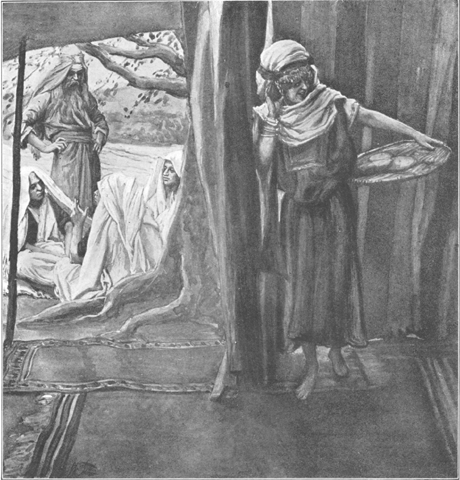
https://upload.wikimedia.org/wikipedia/commons/2/24/Tissot_Sarah_Hears_and_Laughs.gif
Why is it that when men experience Divine revelation, in all three western religions, the human male is most often given credit for his role?   (When a woman experiences Divine revelation, often she is relegated to the background.)
 
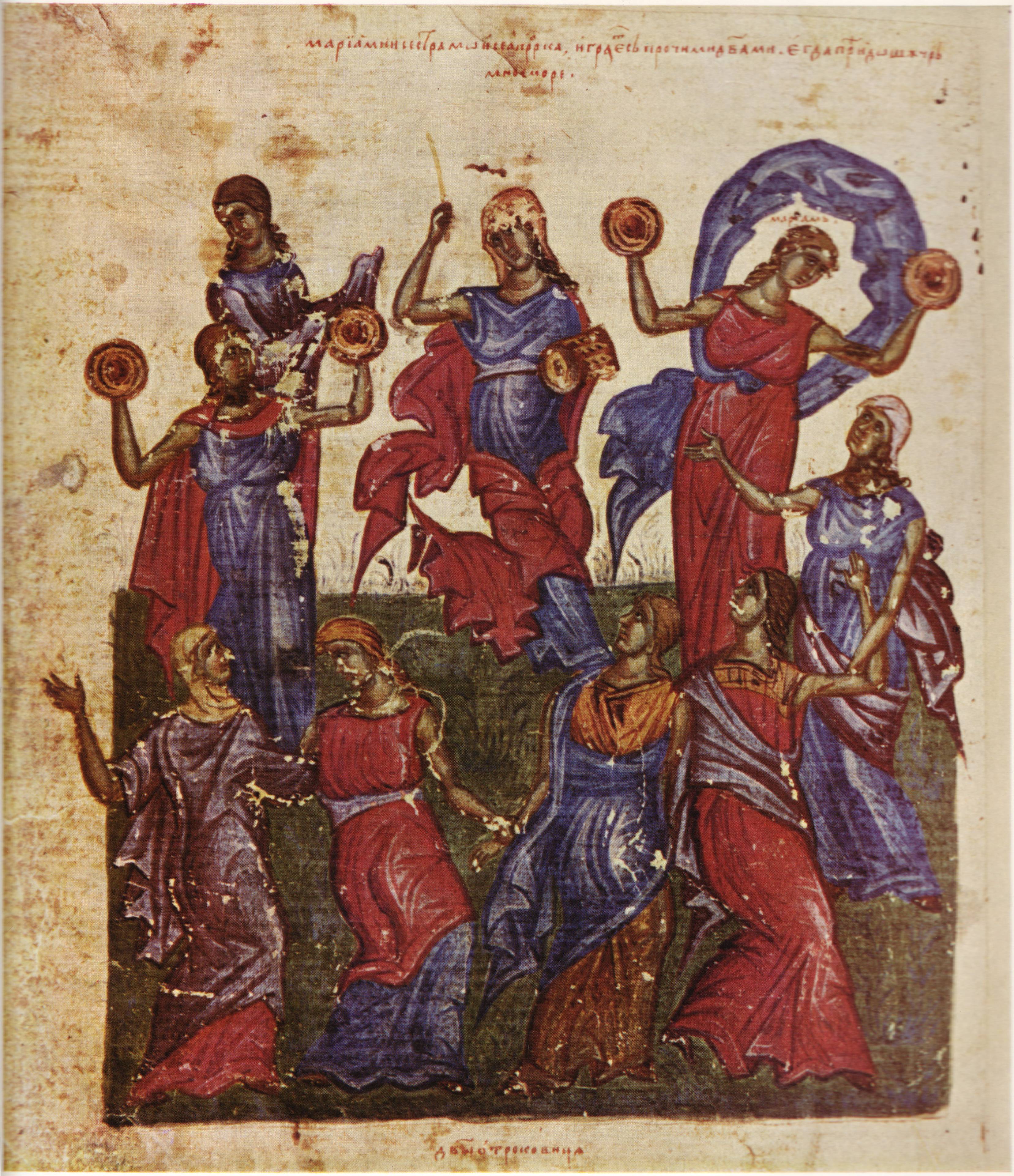
Also, how are Hannah and Deborah uplifted in the Hebrew & Christian Scriptures?... Are their revelations attributed singularly to God?  Both Moses and Aaron receive instructions from Adonai in the book of Leviticus.  Prophet Miriam, Moses' sister, stands beside them throughout their journey. From her singing and leading people safely out of the Red Sea, she seems an empowered leader, as depicted in this painting.
 http://upload.wikimedia.org/wikipedia/commons/7/76/Miriams_Tanz.jpg

However, she is not named in Leviticus.  Is her being afflicted with leprosy an act of Adonai in response to female insubordination? OR, are male Torah commentators unhappy about her large number of followers? Do they author a cautionary tale to prevent further competition with Moses?

Miriam's Well is not actually in the Torah because it is ubiquitous in Jewish life.
Miriam is called "Miriam the prophet" in the Torah (Exodus 15:20.)  The Torah itself does not mention the marvel/miracle known throughout Jewish history as Miriam's Well.  But the earliest Rabbinic literature explains how the death of each of the three leaders (Miriam, Aaron, Moses) in the wilderness included the great loss of a specific miracle for the people; in Miriam's case, the Well.  Miriam's Well was described as traveling with the people and having healing powers.  The proof text for this idea comes from Numbers 20: 1-2  ". . . Miriam died there and was buried there.  The community was without water, . . . "  Furthermore, in Rabbinic literature, Miriam is often written about in parallel to her brother Moses, and often given equal status.


What of Haajar (Hagar)?

Why is not more made of her conversation with Angel Gabriel and her journey which Muslim pilgrims follow? Historically, Hagar remains in the background.

Why in Christianity is the Gospel of Mary (Mary Magdalene) rarely discussed and not read aloud Sunday mornings alongside Mathew, Mark, Luke, and John?  http://www.gnosis.org/library/GMary-King-Intro.html

What of Mary's possible marriage to Jesus, as described in the rarely acknowledged Gospel of Philip?

Why are only men considered Jesus' disciples?  No one knows who attended Jesus' last supper. Mother Mary, along with Mary Magdalene, and the two faithful sisters Mary and Martha must have been present.   After all, they never left his side at his death (even though male followers ran away to save their lives.)

We can guess by context (and since Hebrew and Arabic are gendered languages) that the Divine, speaks through angels and directly to prophets, addressing in many cases both men and women. Why even today in 2013 are women still separated from the original experience and teaching?

M. remembers as a child how surprised she was to see Jesus' patriarchal lineage listed in the N.T.  Wasn't the Holy Spirit supposed to be his daddy?

D. teaches us that in the Qur'an when a man asks to whom is he to be dutiful, three times the answer is "to your mother."

http://lostislamichistory.com/wp-content/uploads/2013/01/Aurangzeb_Handwritten_Quran.jpg

Let us all reclaim that sacred duty.

Tuesday, February 5, 2013

Fiddler on the roof - Lechaim (with subtitles)

 K: As a feminist deconstructionist metaphysical Christian, I have been studying POWER VS. FORCE by David Hawkins. He speaks about the vibrational power of emotional states such as despair, shame, guilt, and fear compared to Love, Joy, and Appreciation. According to his work, what we might call damaging emotions barely register above 20 on a consciousness scale while love (and above) begin around 520 and continue to 1,000 - the level of spiritual masters.

Question 1: In your traditions of Islam and Judaism, do your Scriptures make a similar distinction... or is this a post modern construct?

M: In Judaism God puts before humanity - Life and Death. We are asked to choose life. In our celebrations we say, "Lechaim!" or "L'Chayim!" which again directs us to life! Shabbat invites us to focus - for 24 uninterrupted hours - on life and joy, even the joy of making love! 

K: That is quite a contrast to the Christian imperative originating from American Puritanism and the Pilgrims to refrain from any fun at any time. 

D: Ramadan also is also about celebrating, connection to Allah, life, and community. Humorous aside: One of the highlights of our being together is playfulness, which transcends cultural and religious barriers. 

D. mentioned, in the context of Ramadan, that her Middle eastern friend, when she arrived in America, was happy to see what she assumed were all the Muslim hotels because of their name - the Ramada chain. We all chuckled.

K: It is not only David Hawkins who lectures and writes about the power of positive emotions and thinking, but the teachings of Abraham-Hicks center on this. According to them, simply being (as opposed to doing) gives a healing effect on the world. Do y/our three scriptures say anything about this? 

K: Jesus says not to cast your pearls before swine, which could sound offensive. I am wondering if he means that if you are in a positive healing emotional state, are we encouraged to stay there and create something in the present that is positive rather than turn back to the negative past and become distracted by all of its' illusions and dysfunction? Are we to focus on creating a solution, rather than become overwhelmed and depressed about the problem? 

 M: Shabbat is about beingness. Many Jewish leaders describe religious Judaism as being composed of THREE PATHS: STUDY, PRAYER, AND ACTS OF LOVING KINDNESS. 

 D: Yes, Islam also teaches what is called the Middle Way. One should not become too involved in particulars, not too extreme. (We all laugh, again, considering the extremes in world politics and extremist actions from all 3 religions, which receive media attention.)

 D: Neither are we too become too lax. Moderation and compromise are the key. All three of us wonder if being-ness came easier for our ancient ancestors who lived in agricultural communities and who were hunters/gatherers. Did they understand connection to God more naturally than we post modern egotists? 

K: Hmm.  Psalmist David cries out about separation from Adonai.  His writings are thousands of years old.

 M: The Commandments are better translated and understood as the Connections TO GOD. IT DEPENDS ON WHICH VOWELS YOU PUT IN. ONE KEY CONNECTION TO GOD IS SHABBAT WHICH IN THE TORAH IS MODELED AFTER GOD RESTING AFTER CREATING THE WORLD, AND ALSO THE STORY OF REDEMPTION AND REVELATION IN EXODUS. 

K: That would fit with the positive emotions that Hawkins describes as innate within us. It is unfortunate that the commandments are understood by most people as prohibitions and limitations.

M. & D: Here's an interesting cultural difference having to do with ego and God.  In Spain and in the Middle East, one does not say "Thank you" to someone personally. People offer their generosity and kindness because this is the right way to be. To show appreciation one might respond, "Thank you, to God, that this was done." In Spain (historically, reflecting the Muslim influence) one might say, "O'Jala" which means "If God wills." This sounds like "In sha Allah." 

K: I like that. Instead of focusing on the individual (and possibly their lower ego) in appreciation we are pointed back to God's generosity and care. 

NEXT POSTING & MEETING: Sunday, February 17th - Gender & Sexuality

Israel and Iran: A love story?